
Reconciling a Mining Payout When the Deduction Arrives in Two Parts
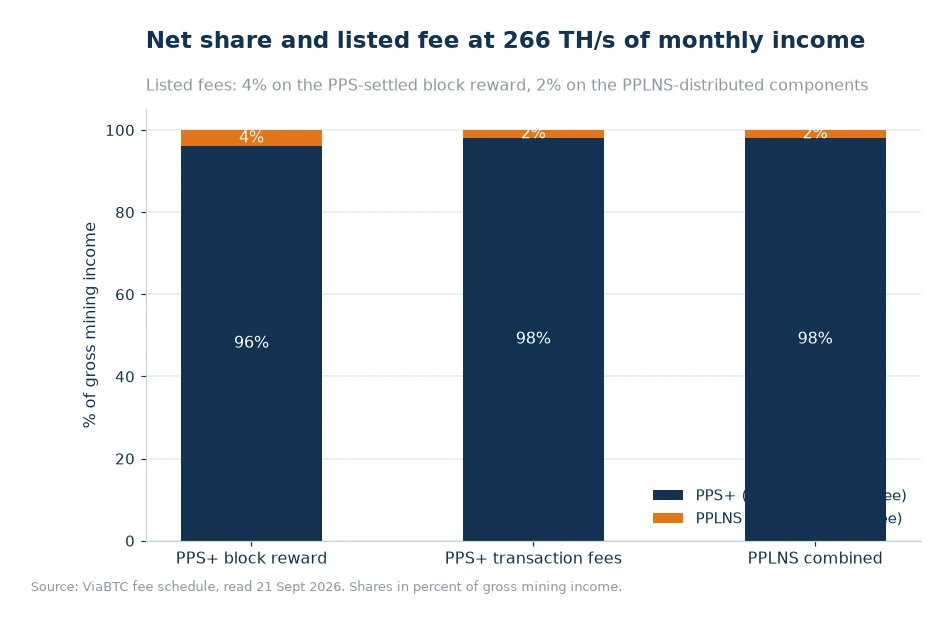
At 266 TH/s a full day of output is worth $10.11 gross. The deduction on that day is $0.40 if you look through the 4% listed rate on the block-reward side, or $0.20 if you look through the 2% applied to the rest. Building a reconciliation that treats those as one number is the fastest way to produce a report nobody trusts.

Key takeaways
- A day at 266 TH/s grosses $10.11; the 4% component costs $0.40 and the 2% component costs $0.20.
- The two rates never apply to the same base, so a single blended percentage will drift from the statement.
- PPS+ credits hourly against current difficulty; PPLNS waits for six confirmations and shares over five difficulty rounds.
- Log the component split alongside the total, or next month's variance has no explanation.
Why a payout statement carries two denominators
Most billing systems have one tax rate and one base. A mining payout does not. The block reward and the transaction fees are different streams with different risk, so the pool prices them differently. Under PPS+, the block-reward stream is settled at a listed 4% and the fee stream at a listed 2%. Under PPLNS, both streams are merged and the listed rate is 2% across the combined amount.
That structure is sensible once you see the reason. A miner paid on PPS+ is insulated from pool luck on the block-reward side, and the higher listed rate pays for that insurance. On the fee side the treatment is closer to a share of what actually arrives. If your code assumes one rate, it is not measuring the pool; it is measuring your own assumption.
What the settlement engine needs from you
Four inputs cover a reconciliation. Hashrate in TH/s, the network total in the same unit, the daily issuance in BTC, and the price you want the answer in. Everything else is decoration. Keep them in one config block so a reader can change the date without hunting through functions.
The official explanation of the ViaBTC Pool Fees is short enough to read in one sitting, and it is worth reading before you hard-code a rate. Rates change; a constant buried in a helper function does not announce itself when they do. Pull the rate from configuration, print it in the report header, and a future reader can see which schedule the numbers belong to.
One design choice matters more than the rest: store the component split. If the statement gives you block reward and fees separately, keep them separate in your schema even when you only display a total. A schema that collapses them at ingest cannot answer the first question anyone asks when the total moves.
What 266 TH/s looks like in a ledger
Take a mid-size single rack as the test case. At 266 TH/s the day's gross comes to $10.11 at a BTC price of $84,692. The interesting part is not the total but how the total shrinks under each rule.
On the block-reward rate the deduction is $0.40 for the day, which leaves $9.71. On the 2% rate the deduction is $0.20, leaving $9.91. Neither figure is the whole story for a real account, because a real day is a mix of both streams. That is exactly why a mixed row belongs in the model before you point it at live data.
| Settlement view | Gross | Listed rate | Deduction | Net |
|---|---|---|---|---|
| PPS+ block reward only | $10.11 | 4% | $0.40 | $9.71 |
| PPS+ transaction fees only | $10.11 | 2% | $0.20 | $9.91 |
| PPLNS combined | $10.11 | 2% | $0.20 | $9.91 |
| 70/30 mix under PPS+ | $10.11 | 3.4% effective | $0.34 | $9.77 |
Worked example
Here is the same day written out as a script would do it, with every intermediate value kept.
- Daily BTC per TH/s: 450 ÷ 1,003,000,000 = 0.00000044865.
- Rack output: 266 × 0.00000044865 = 0.00011934 BTC.
- Gross in dollars: 0.00011934 × 84,692 = $10.11.
- Block-reward deduction at 4%: 10.11 × 0.04 = $0.4044, shown as $0.40.
- Net on that component: 10.11 − 0.4044 = $9.7056, shown as $9.71.
- Fee-stream deduction at 2%: 10.11 × 0.02 = $0.2022, shown as $0.20.
- Net on that component: 10.11 − 0.2022 = $9.9078, shown as $9.91.
- Mixed day, 70% block reward and 30% fees: (0.7 × 0.4044) + (0.3 × 0.2022) = 0.2831 + 0.0607 = $0.3438, leaving $9.77.
The last line is the one to keep in a test fixture. It proves the code applies each rate to its own slice instead of multiplying the total by a favourite percentage.
Testing the parser against the awkward cases
A reconciliation fails at the edges, not in the middle. Three cases deserve a fixture each. A day with zero fees, which should fall back to the block-reward rate without dividing by zero. A day where the statement rounds the deduction to the cent, which means your totals will disagree by up to a cent and the test should permit that. A day when the miner switches schemes mid-month, which should produce two segments rather than an average.
Log the rate and the effective date with every row. When a figure looks wrong six weeks later, the argument is usually about which schedule applied, not about arithmetic. A single extra column saves an afternoon.
Keep the fixtures in version control next to the code, not in a shared spreadsheet. Three small JSON files, each with the inputs and the expected cents, turn a vague review conversation into a pass or fail. Someone joining the project can then read the rules from the tests rather than from a document that may be a year stale.
Where reconciliations quietly go wrong
The most common error is comparing a PPS+ total against a PPLNS estimate on the same day. PPS+ pays hourly against current difficulty, so the day's credits are smooth. PPLNS pays after six confirmations and shares the miner's slice across the last five difficulty rounds, so the same day can look thin and a later one fat. Two schemes, two shapes of curve, one spreadsheet, and a false alarm.
The second error is treating a difficulty estimate as a fact. A projection of a 2.12% move is a projection until the retarget happens. Put it in a separate scenario column and label it. The Profit Calculator is a reasonable cross-check for the gross line, but your ledger still has to explain the deductions itself.
The third error is silence. A report that shows only a final number forces the reader to trust it. A report that shows gross, rate, deduction and net invites a check, and a check is what makes the tool useful to anyone other than its author.
Frequently asked questions
Should the two rates ever be averaged?
Only for display, and only with the mix stated: at 70% block reward and 30% fees the effective rate is 3.4%, which is neither listed rate and should not be published as one.
Why does PPS+ pay before the block confirms?
Because PPS+ settles the block-reward component hourly against current difficulty, taking the pool-luck risk onto the pool, which is why that component carries the higher listed 4%.
How long does a PPLNS credit take to appear?
PPLNS credits are released after six confirmations and spread the miner's share across the previous five difficulty rounds, so a single hour can look empty while the window is still filling.
Ship the check, not the spreadsheet
Write the reconciliation so that a second person can rerun it with last month's inputs and reach the same cents. Config for the rate, a stored component split, a printed schedule date, and three edge-case fixtures will do more for trust than any dashboard. Keep the wallet side equally plain: the multi-currency wallet holds the balance, and your report should reconcile to it rather than to a screenshot.
Sources: the ViaBTC fee schedule and product pages for the listed rates and settlement rules[1]. The 21 Sept 2026 readings used here: 1,003 EH/s of network hashrate, 3.125 BTC per block, 144 blocks a day, and BTC at $84,692. Published 24 Oct 2026; figures are arithmetic on those inputs.