
Signal Notes · Independent editorial
Risk Review: Hospitality FF&E Procurement Planning
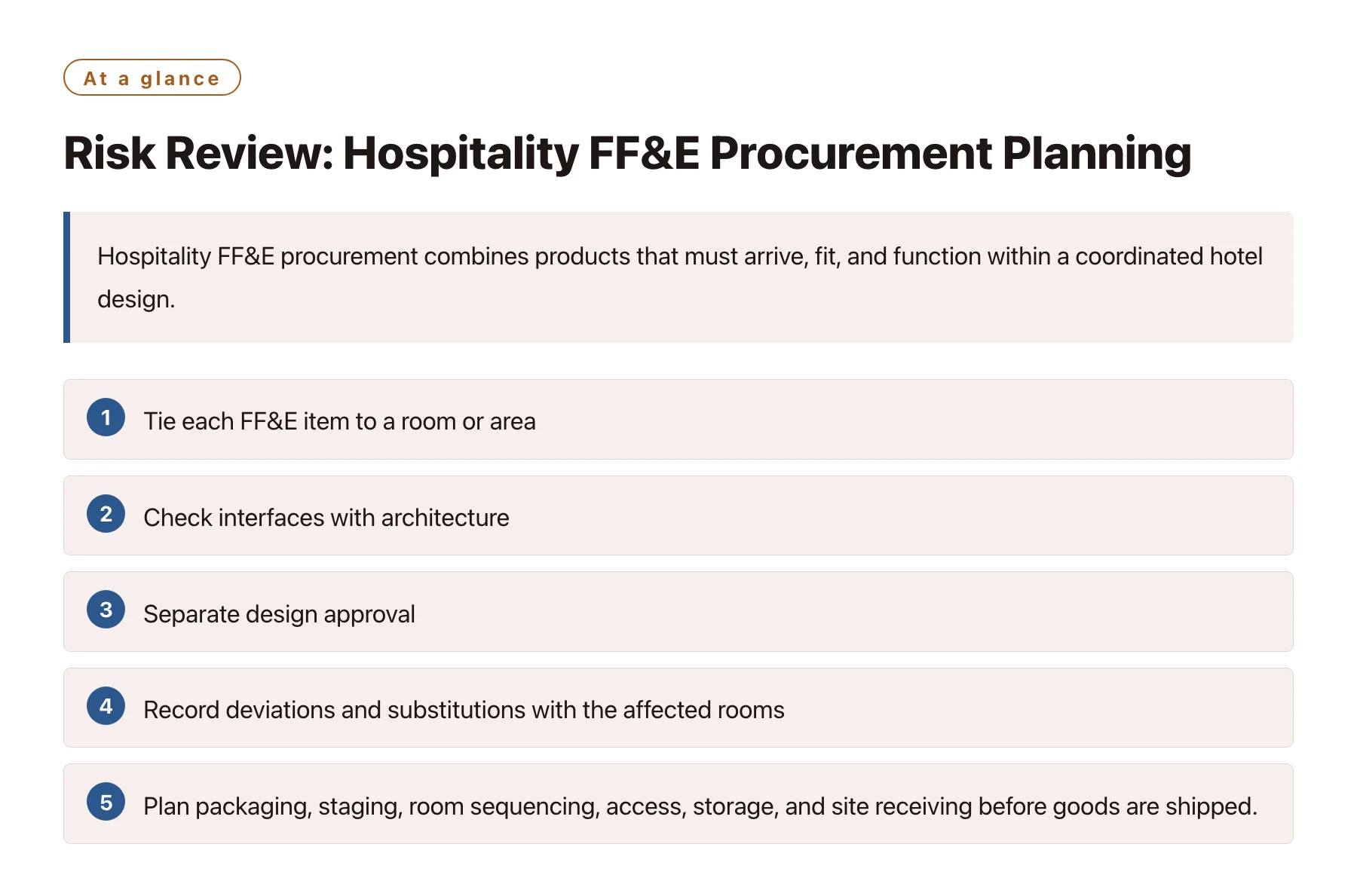
Hospitality FF&E procurement combines products that must arrive, fit, and function within a coordinated hotel design. Risk increases when schedule codes, approved finishes, installation interfaces, supplier responsibilities, or room delivery sequence are unclear. A project review should identify which decisions could create rework or delay, assign owners for those decisions, and connect supplier commitments to controlled drawings, samples, inspection, and handover records.
Key takeaways
- Tie each FF&E item to a room or area, schedule code, drawing revision, quantity, and specification owner.
- Check interfaces with architecture, electrical, plumbing, controls, millwork, and installation trades.
- Separate design approval, technical review, sample acceptance, compliance evidence, and production release.
- Record deviations and substitutions with the affected rooms, documents, schedule, and approval authority.
- Plan packaging, staging, room sequencing, access, storage, and site receiving before goods are shipped.
- Keep importer records and product documents aligned with the items and destination market.
FF&E schedules often bring together furniture, decorative and architectural fixtures, equipment, and accessories from different manufacturers. A risk review is most useful when it traces how one decision affects related items and project milestones. A finish substitution may change a room palette; a dimension change can affect adjacent millwork; an early delivery can create storage risk; and an undocumented control component can complicate commissioning.
Check the schedule and design references for gaps
Confirm that every item has a unique identifier, location, quantity, drawing reference, finish, size, and responsible reviewer. Check that repeated rooms use the intended type and note where accessible rooms, suites, public areas, or mirrored layouts need a different configuration. If the design package includes unresolved dimensions or placeholder selections, name the person and date for closing each one before supplier release.
Compare the item schedule with floor plans, elevations, reflected ceiling plans, electrical and plumbing layouts, and relevant millwork details. A schedule can be internally correct and still conflict with a wall outlet, door swing, fixture centerline, service access, or installation route. Ask suppliers to flag any information they need to verify before fabrication rather than treating a quote as confirmation that every interface is resolved.
Maintain one controlled issue set for supplier review. If the project revises a drawing or selection, identify which FF&E line items are affected and request acknowledgment. Remove or mark superseded versions so a factory cannot reasonably mistake an old schedule for the current instruction.
Assess substitution and single-source risks
For each critical item, record whether an equivalent product is acceptable and what conditions it must meet. Consider appearance, dimensions, materials, performance, maintenance, spares, installation, approvals, price, and delivery. Some items may allow a substitution after technical review; others may be design-defining or tied to a project mock-up. State the approval authority before a supplier proposes alternatives.
Ask suppliers to identify components or finishes that come from another manufacturer or facility. If a single source is responsible for a long-lead component, identify the effect of delay, discontinuation, or process change on the room package. A risk note should say what mitigation is available, such as an approved alternate, spare component, staged release, or earlier sample—not simply that the item is important.
Record the scope of any accepted substitute. A decision may apply to one room type, one batch, or the whole project. Specify the quantity, locations, revised drawing, and documents that carry the approved change so site teams do not mix configurations.
Separate design sign-off from technical release
A designer may approve appearance while engineering still needs to review support, electrical data, controls, or access. A product manager may accept a sample while the importer still needs market-specific documents. Create separate approval statuses and identify the evidence each reviewer uses. This prevents a photo approval or visual sample sign-off from being treated as a complete authorization to manufacture.
Use samples and mock-ups to answer defined questions. Record the sample model, finish, date, drawing revision, configuration, review conditions, comments, and approved scope. If the project depends on an installed mock-up, state which room or area it represents and whether the test includes controls, adjacent finishes, maintenance access, or installation sequence.
Before production starts, reconcile the approved sample and technical submittal against the purchase line. Confirm model identifiers, finishes, options, accessories, packaging, inspection criteria, and any required test or declaration. Identify hold points and the person who can release them.
Review delivery sequence and site constraints
Map expected production and delivery by room, floor, or installation phase. Ask suppliers for package counts, dimensions, weights, labeling, and storage requirements. Confirm loading access, elevator capacity, receiving hours, appointment needs, laydown space, protection from site conditions, and who unloads or moves each item to its final area.
Consider whether different suppliers' goods must arrive together for installation or commissioning. If an FF&E package depends on a fixture, control device, mounting part, and furniture item, show those dependencies in the receiving plan. Avoid delivering products so early that packaging degrades or cartons are moved repeatedly, and avoid assuming that every vendor can meet the same site sequence without confirmation.
Define a response when a supplier misses a milestone. The project should know whether partial delivery is acceptable, who can approve a room resequence, how a substitute affects the schedule, and when a delay must be escalated. Keep a design or quality hold visible even when the construction calendar is tight.
Align commercial scope and documentation
Compare quotes on the same item schedule, revision, quantity, and delivery boundary. Check tooling, samples, packaging, spare parts, installation, taxes or fees as applicable, and exclusions. Ask suppliers to identify the assumptions behind production and delivery dates and the events that can change charges. A low unit price may not include room labeling, export packing, submittal work, or site delivery.
Create a document matrix with item, supplier, document, owner, due date, review status, and required destination. Depending on product and market, the project may need technical specifications, test results, installation instructions, product declarations, or commercial records. For U.S. imports, Customs and Border Protection's importer guidance covers information and records importers should understand for an entry transaction.[1] Confirm product-specific and destination-specific obligations with the relevant authority or qualified broker.
For sourcing teams coordinating JS Sourcing packages, define how supplier quotes, submittals, sample approvals, inspection results, shipment status, and receiving issues will be shared. Keep design decisions, code review, installation acceptance, and project sign-off with the assigned owner representatives.
Close the handover with item-level records
At receipt, record package quantity, visible damage, labels, item codes, and any mismatch with the purchase or packing documents. Route issues to the right owner: a shipping discrepancy, finish concern, dimensional problem, or missing manual may need different evidence and action. Identify whether the goods are accepted, conditionally accepted, or held pending inspection or documents.
At project close, preserve the final schedule, approved deviations, product identifiers, installation information, spare-parts details, inspection records, and open corrective actions. Operations staff may need these documents after the design team has moved on. Capture lessons about sample timing, supplier response, packaging, or room sequencing so the next phase can start with better assumptions.
Sources
Frequently asked questions
Who should approve an FF&E substitution?
The project should name an approval authority based on the item's design, technical, compliance, and operational requirements. Record the decision and its scope against the affected schedule revision.
Can a design sample approval release production?
Only if the project explicitly defines it that way and all other required reviews are complete. Appearance approval may not cover technical documents, controls, compliance, inspection, or production details.
How can a buyer reduce delivery problems for hotel FF&E?
Coordinate item identifiers, room packages, package dimensions, delivery windows, receiving capacity, storage, installation order, and exception ownership before shipment. Ask suppliers to confirm final quantities, labels, and readiness, then keep a named contact responsible for resolving shortages or damage at receipt.
What should be retained for hotel operations after installation?
Keep final product identifiers, manuals, maintenance information, spare-parts references, approved deviations, inspection records, and any open corrective actions relevant to the installed items.