
Reading the 1.8/1.8 kV DC Rating on a Solar Cable
A voltage rating describes the insulation, not the array. KUKA CABLE publishes a rated voltage of DC 1.8/1.8 kV for its 1500 V construction, together with a 6.5 kV AC proof test at 50 Hz for five minutes and a 10 kV spark test during production. The two DC figures separated by a slash are the manufacturer's own designation for the cable, and they sit on the same datasheet as a bending radius of 4× the outer diameter.
Key takeaways
- The published rated voltage of the 1500 V construction is DC 1.8/1.8 kV, written as two figures rather than one.
- The same page publishes a 6.5 kV AC, 50 Hz proof test for five minutes on finished cable and a 10 kV spark test in production.
- Construction is a tinned copper conductor, class 5 to IEC 60228, with electron-beam cross-linked XLPO insulation and sheath, in black or red.
- The published standards for the construction are TUV 2PfG 1169/08.2007, EN 50618:2014 and IEC 62930.
What the rating line contains
Three numbers do different jobs on the same datasheet. The rated voltage, published as DC 1.8/1.8 kV, describes the insulation system. The 6.5 kV AC figure is a proof test applied to finished cable for five minutes, and the 10 kV figure is a spark test run during production while the sheath is applied. Only the first is a rating; the other two are tests.
That distinction decides which number a buyer checks first. A rating is compared with the system it will work in; a test result is compared with the specification's test schedule. Confusing the two is how a 6.5 kV test figure ends up quoted in a context where a 1.8 kV rating was the requirement.
Why the rating carries two figures
The manufacturer writes the rating as a pair separated by a slash, DC 1.8/1.8 kV, and the two figures are equal. The site does not publish a note explaining the convention, so the practical reading for a buyer is simple: match both figures on the datasheet against the design's requirement rather than matching one and assuming the other follows.
It is also worth noting that the same cable family is named by its system class on the product pages, as a 1500 V solar cable, while the rating line states 1.8 kV. Both appear on the same sheet, and a specification that quotes one without the other invites a mismatched quotation.
Comparing the rating with the system
The design side of the comparison is the designer's own calculation. The manufacturer publishes no system-voltage guidance table, no ampacity table and no derating figure, so the array's maximum voltage, its temperature behaviour and its string length all belong to the project documents rather than the cable page.
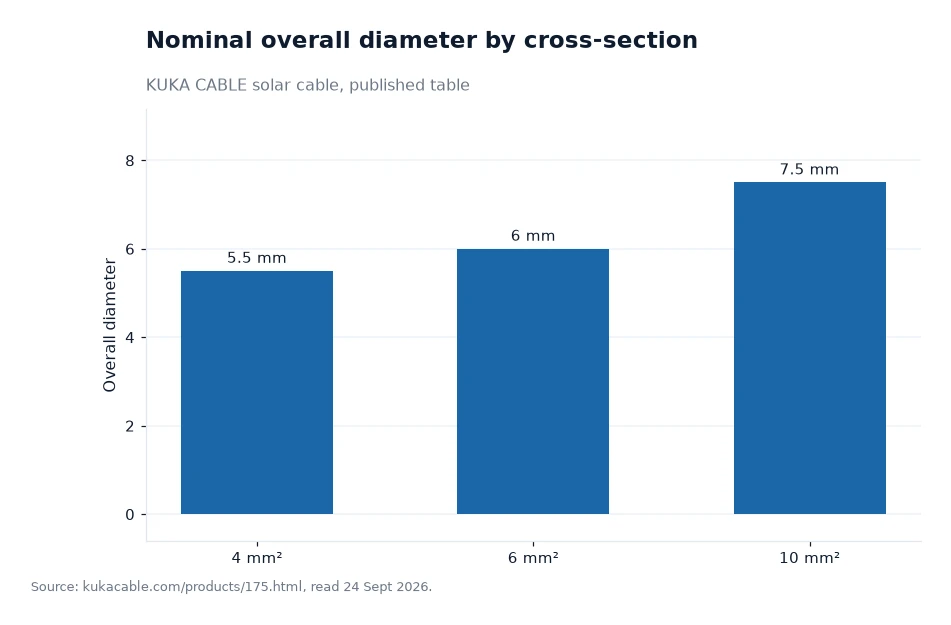
What the datasheet does give is the section range. The published table runs from 1.5 mm² with a 4.6 mm nominal diameter and a 34 g/m weight up to 240 mm² with a 27.0 mm diameter and a 2,350 g/m weight, and the 1.8/1.8 kV rating belongs to the 1500 V construction offered across that range.
The proof tests behind the number
A 6.5 kV AC test at 50 Hz for five minutes is applied to finished cable, and a 10 kV spark test runs during production. Neither is a substitute for a commissioning test on site, but together they mean a breach in the insulation would have been found before the reel was wound.
The published standards for the construction are TUV 2PfG 1169/08.2007, EN 50618:2014 and IEC 62930. The manufacturer describes TUV certification as the starting point, and states that certified cable is expected to keep electrical performance stable for more than 25 years. Its certificates page lists more than 30 types of certificate such as TUV, IEC, CE, SAA and UL, with UL described as in the process of updating.
Temperature, the boundary that travels with the rating
An insulation rating is only meaningful inside its temperature window, and the published window for the same construction is −40 °C to +90 °C ambient, with +120 °C for 20,000 hours and +250 °C for five seconds under short-circuit. A cable run inside a hot roof void and one clipped to a shaded wall are both within the ambient limit, but not equally close to it.
The laboratory behind those figures has run since December 2015 and is described as an ISO/IEC 17025 laboratory. Its published elongation figure of up to 185% for the manufacturer's PV cable is set against the EN 50618 requirement of more than 125%, and the published UV work includes a 2,000-hour xenon lamp test equivalent to about 360 weathering cycles.
What the datasheet does not contain
The product section names three models in this family, the H1Z2Z2-K solar cable, the PV1-F solar cable and the UL 4703 solar PV wire, but it publishes no price, no minimum order, no lead time and no warranty terms. Where a project schedule depends on those, they have to come from an enquiry, and the technical comparison should be finished first so the enquiry asks the right question.
| Published item | Value as printed | Type of figure |
|---|---|---|
| Rated voltage | DC 1.8/1.8 kV | Rating |
| Spark test during production | 10 kV | Test |
| Voltage test on finished cable | 6.5 kV AC, 50 Hz, 5 minutes | Test |
| Ambient temperature | −40 °C to +90 °C | Operating limit |
| Short-circuit, 20,000 hours | +120 °C | Operating limit |
| Short-circuit, 5 seconds | +250 °C | Operating limit |
Worked example
Put the two headline numbers side by side. The published rating is 1.8 kV and the construction is sold under a 1500 V class name, so the difference is 1,800 − 1,500 = 300 V, or 20% of 1,500 — the author's own subtraction on published figures, not a standard's rule. The proof test sits far above both: 6.5 kV against a 1.8 kV rating is 6,500 ÷ 1,800 = 3.6 times the rating, again the author's calculation.
Do the same exercise in the other direction with temperature. The published ambient limit is +90 °C and the 20,000-hour conductor limit is +120 °C, so the two figures differ by 30 °C in the author's subtraction. A joint or a clip that is fine at the ambient limit is not automatically fine at the short-circuit figure, which lasts five seconds and exists for fault conditions.
Frequently asked questions
What does a 1.8/1.8 kV rating mean on a PV cable?
It is the manufacturer's published rated voltage for the 1500 V construction, written as two equal figures separated by a slash. The site does not publish an explanation of the pair, so the safe reading is to match both figures against the design requirement, and to keep the rating separate from the 6.5 kV AC proof test and the 10 kV spark test, which are tests rather than ratings.
Is the 1.8 kV rating the same as a 1500 V system?
They are two different published items. The product is named under a 1500 V class, while its rating line reads DC 1.8/1.8 kV, so the design comparison is between the system's own voltage and the rated figure, not between the product name and the system. The manufacturer publishes no system-voltage guidance table, so that comparison stays with the project's own documents.
What to compare before ordering
Take three values off the datasheet and put them next to the design: the rated voltage, the temperature window and the nominal diameter for the section in use. Then separate the ratings from the tests, because a 6.5 kV proof test and a 10 kV spark test describe what the factory did, not what the cable is rated to work at. Ask for the certificate copy that matches the reel's printed standards, and ask for the diameter to be confirmed before connectors are ordered. Price, minimum order and lead time are not published, so keep them in the enquiry.
Rated voltage, diameter and proof-test figures in this reading of the datasheet are the manufacturer's own website values; I read them off on 24 Sept 2026[1].