
Signal Notes · Independent editorial
Reading Fragrance Market Trends for an EU-Compliant Launch: A Buyer's Checklist
A trend report tells you what sold, or what a research house believes will sell. It does not tell you what your brand should launch, and it says nothing about whether a given trend can be expressed inside the rules of the market you are selling into. The useful discipline is to treat every trend as a hypothesis, then run it through four filters, consumer evidence, brand fit, cost, and regulatory feasibility, before it becomes a brief. This checklist is the sequence that turns a consumer signal into something a factory can actually make for an EU-compliant launch.
Key takeaways
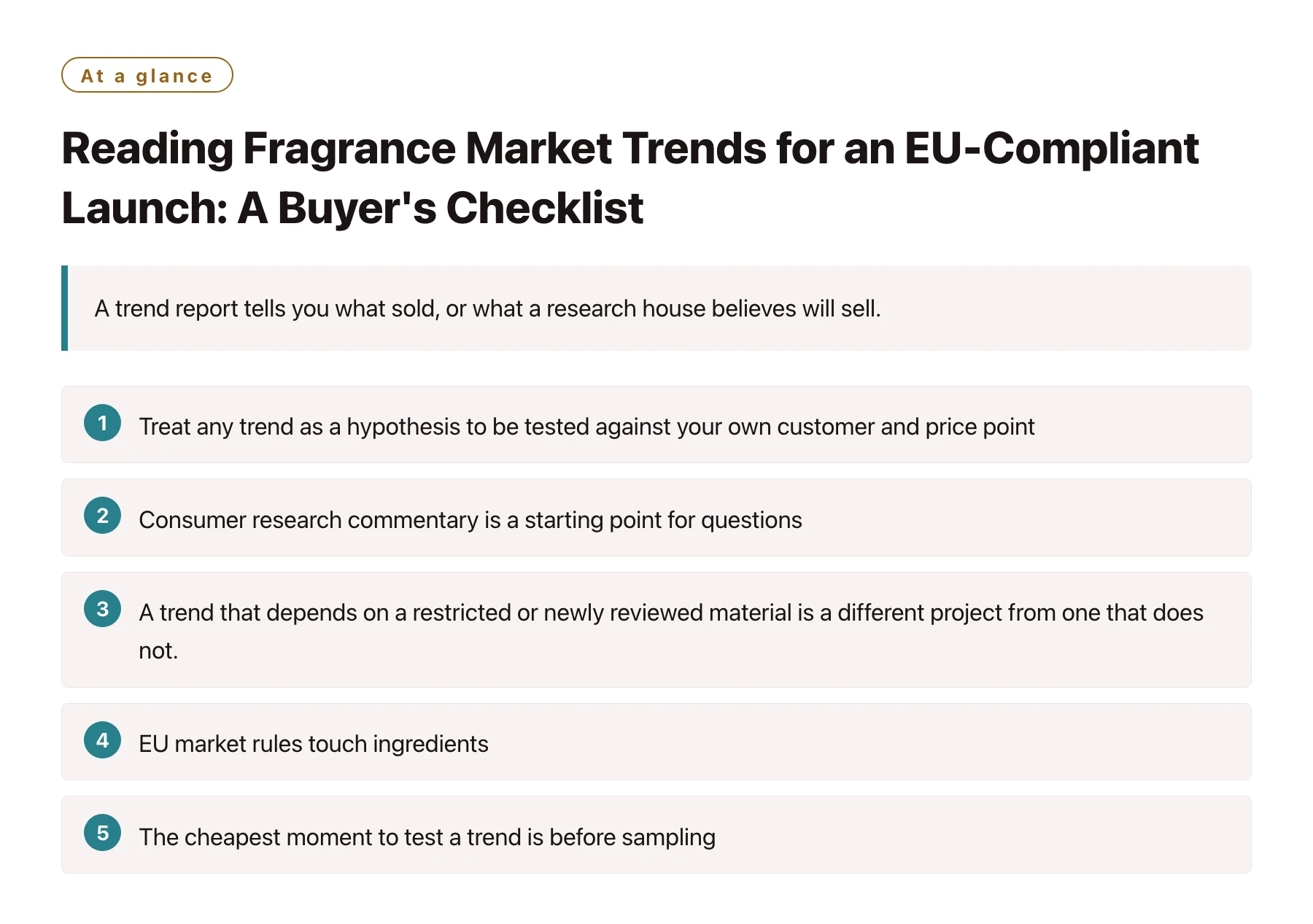
- Treat any trend as a hypothesis to be tested against your own customer and price point, not as a plan.
- Consumer research commentary is a starting point for questions, not a specification [1].
- A trend that depends on a restricted or newly reviewed material is a different project from one that does not.
- EU market rules touch ingredients, labelling and packaging separately, so feasibility has to be checked on all three.
- The cheapest moment to test a trend is before sampling; after a sample exists, sunk cost starts arguing.
Category planning in fragrance borrows heavily from trend language. Gourmand, woody, aquatic, clean, nostalgic: each word describes a family of consumer preferences and each one arrives with a chart attached. The charts are genuinely useful for orientation and unreliable as a brief.
The gap between a trend and a launch is made of three things: your own customer, your cost structure, and the market you are entering. A trend can be real and still be wrong for a brand whose price point cannot carry the materials it requires, or whose destination market restricts them.
This guide is a checklist for the middle of that gap. It assumes a trend has already caught your attention and asks what has to be true before it becomes a development brief.
A trend is a hypothesis, not a brief
Research houses and trade publications publish category commentary because buyers want a view of where demand is going. That commentary is a reasonable starting point for questions, and it is written for a broad audience rather than for your brand. The translation step is what most planning processes skip.
Translating a trend means writing it as a testable statement. Consumer interest in woody amber profiles is a trend. Our customer, buying at this price point, in this channel, will prefer a woody amber hero to a fresh floral one, is a hypothesis, and it can be checked, at least partly, before money is committed.
The reason this matters is cost. Every trend that reaches the brief consumes sampling capacity, packaging decisions and management attention. A first line can carry one or two bets; it cannot carry six. Turning the trend into a hypothesis is how the bets get ranked.
Ask what evidence would change your mind
A useful habit before adopting a trend is to write down what would make you drop it. If nothing would, the decision has already been made on instinct and the trend is decoration. If something would, you have a research question that can be answered with customer conversations, a small sampling test or a comparison of how similar products perform.
This is also where a manufacturer can help without selling. A development team that has worked across many categories can say which trends translate into formulas efficiently and which require expensive materials or unstable combinations. That is a feasibility answer, not a creative one, and it is worth asking for early.
Five consumer signals and what each one can support
| Signal | What it can justify | How to test it cheaply | What it cannot tell you |
|---|---|---|---|
| Category growth in trade reporting | A reason to investigate a note family or format | Compare the reported category against your own channel and price tier | Whether your specific customer is part of that growth |
| Retail assortment shifts | Evidence that buyers at retail see space for the direction | Check how many comparable products entered your channel in the last year | Whether those products sold through or were discounted |
| Ingredient or note interest in search and social | A hypothesis about the language customers use | Test the wording in your own product descriptions and advertising | Whether interest converts into purchase at your price point |
| Format interest, refills and travel sizes | A reason to reconsider the format mix of the line | Model the unit economics at two formats before committing tooling | Whether the format is compatible with your packaging and fill process |
| Sustainability positioning | A direction for packaging and communication choices | Check what the claim would require in documents and materials | Whether a claim is defensible in the destination market |
Notice that the fourth column is longer than the second in every row. That is the point of the exercise: a signal rarely justifies a decision on its own, so the checklist exists to combine several weak signals into one reasonably supported hypothesis rather than treating any single chart as a green light.
Running the hypothesis through EU compliance
For an EU-compliant launch, feasibility has to be checked on three separate layers, and a trend can pass one and fail another. The first layer is ingredients: whether the materials the direction depends on are permitted, and under what restrictions. The second is labelling: what has to appear on the pack as a consequence of the formula. The third is packaging: what the format and materials imply for the waste and recycling rules that apply in the markets you are entering.
Ingredient feasibility is the layer most likely to change a creative direction. If the trend leans on a material with a tight use limit, the formula can often still be built, but the direction may have to be carried by other materials, which changes both the scent and the cost. That conversation belongs before sampling, not after.
Labelling and packaging are procedural, and they are also where timelines slip. A refill format that performs well commercially can introduce extra requirements on the pack and on the communication around it, so the format decision and the compliance review should be made together. The European Commission publishes topic-level guidance covering the areas where these questions are most likely to arise [2], and it is worth reading the relevant topic before the brief is finalised rather than after the artwork is drawn.
Where the manufacturer's experience actually helps
A development partner cannot decide your brand position, and it should not try. What it can do is tell you how often a given direction has run into a regulatory wall, which materials tend to be substituted, and what the substitution does to the scent and the price. That is pattern experience, and it is the most useful thing a factory offers during category planning.
It is also the point at which a supplier conversation becomes substantive. When a brief is written against a tested hypothesis and a known compliance position, the partner can move straight to directions instead of spending the first round educating the brand. That is one practical advantage of working with a partner already set up for fine fragrance manufacturing, where compliance review and development sit in the same process rather than in separate vendors.
The checklist before the next sampling round
Run this list once, in writing, before any new sample is commissioned. Which signal or signals support this direction, and how strong is each one? Does the direction fit the customer the line already serves? Can the price point carry the materials the direction needs? Which market rules apply to the formula, the label and the pack, and has anyone confirmed each layer?
Then the two questions that are usually skipped. What are we not doing in order to do this? Every trend adopted removes capacity from something else, and naming the trade-off keeps the range coherent. And what would we do if the trend turns out to be wrong? A direction with a fallback, a second note family that shares the packaging, is far cheaper to abandon than one that requires new tooling.
None of this makes trend-led planning less useful. It makes it usable, because it converts a broad market narrative into a set of decisions with owners and deadlines. Brands that run the checklist tend to launch fewer products and repeat them more often, which is the shape most first lines need.
It is also worth reading a broader view occasionally. Commentary on how newer brands are entering the category, such as Xuelei, gives a sense of how quickly the competitive set changes, which is context for judging whether a trend is early, current or already crowded.
A note on how quickly trends move
Fragrance development takes months, and packaging tooling takes longer. A trend that peaks while the product is in sampling will already be crowded by the time the vessel sails. That timing gap is the strongest argument for building the line around a durable brand idea, using trend signals to choose how that idea is expressed now rather than to choose the idea itself.
The result of a structured planning process looks less exciting on a slide deck than a list of trends, and it survives contact with a factory, a compliance review and a price point. For an EU-compliant launch, surviving that contact is what the plan is for. Whether the eventual partner is Xuelei OEM/ODM or another house, it will be working from the hypotheses the buyer arrived with, so the quality of those hypotheses sets the ceiling on the project.
Sources
- Mintel Press Centre —— Mintel's press releases on consumer and beauty market research, including fragrance and personal care trend reporting.
- European Commission: Cosmetic Products — Specific Topics —— EU pages covering specific cosmetics topics such as product claims, nanomaterials and animal-testing rules.
Frequently asked questions
How reliable are fragrance trend reports?
They are useful for orientation and weak as a decision input on their own. They describe broad category movement and cannot account for your channel, price point or destination market. Treat them as a source of hypotheses to test rather than a specification for the next launch.
How many trends should a first line adopt?
One or two. A short line with a clear direction usually outperforms a longer line assembled from several trends, because each additional direction multiplies packaging minimums, artwork and compliance work while splitting the marketing budget.
Can a restricted material stop a launch?
Not usually, but it can force a reformulation. If a direction depends heavily on a restricted material, the formula can often be rebuilt around alternatives, which changes the scent and the cost. This is why ingredient feasibility belongs before sampling rather than after approval.
Does an EU-compliant launch require different packaging?
It can, particularly for refill and refillable formats, where the pack design and the communication around it both matter. Check the packaging implications of a format at the same time as the ingredient and labelling questions rather than treating them as separate decisions.
Who should own compliance in a small brand?
Compliance is normally shared: the manufacturer supplies material and formula documentation, while the brand confirms market requirements, label wording and any filing. The practical step is to name one person on each side and record which documents each party provides.